Body Interior:
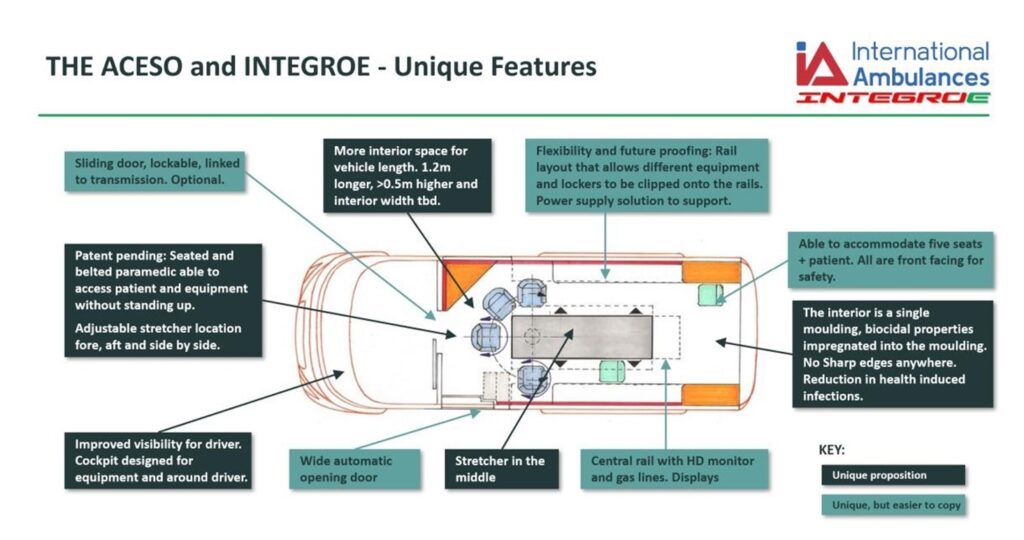
Much care has been spent on making the inner areas as safe and serviceable as possible. Every surface has a curved shape and edges eliminating sharp corners. In 2019, 9000 hours were lost due to paramedics falling over and hurting themselves on sharp worktop-type corners. Overhead storage units are built into the walls on each side together with specific storage cupboards and work surfaces below.
There is now no need for paramedics to stand over a patient as we have a dedicated safe seat with a seat belt. This seat moves around the patients upper body on a curved “U” shaped track set into the floor. Combined with the centrally located stretcher the paramedic now has180 degrees of patient access while seated.
There are two ceiling mounted tracks that have attached rotating mounting brackets for the blood / air / x-ray equipment. We also have an X-ray machine which is ceiling mounted and this can operate robotically for inner sterilisation. There are four movement cameras and two oxygen/ Co2 sensors, inside the patient area to ensure that the patient area is vacant before the sterilisation operation is set in motion. Red warning lights and an audible warning are activated and the doors lock before the X ray machine travels down the ambulance interior going 360 degrees horizontal and 180 degrees vertical to 100% sterilise the interior in 3.4 minutes. The green light outside then comes on and the doors unlock.
There is a driver / patient area bulkhead, fitted with an acrylic bulletproof sliding door for paramedic security and safety. This also means the driver and any other paramedic do not have to get of out the ambulance to enter the patient area. This is a feature that the unions are looking to standardise in the UK market.
The driver’s department has two air-suspended seats, that are adjustable to the paramedic’s weight and hat can recline 30 degrees, raise and lower. The driver has an electric pedal box that can be electrically switched back or forward to suit their height. Two air conditioner units are fitted, one for the full driver’s area and the other for the patient area. The driver’s unit has a third area to cool cans and bottles of drink whilst there is a 12-volt kettle and mugs recessed in the dash. Dual Zone Air Conditioning is taken seriously, especially in extreme circumstances where temperatures of forty-five degrees plus are reached. It is imperative to maintain a comfortable and safe climate within the ambulance for the patient and crew. With the rear tailgate open an air blanket effect is formed with double the power of A/C to ensure minimal temperature disruption. Battery consumption is also supported by a backup from one of the additional three battery compartments of the total of four packs installed